

Monuments Class Projects
Architect/Sculptor of Monument
George Gilbert Scott (1811-1878)
Preview
Medium
photograph, carte-de-viste
Keywords
Albert Memorial, Prince Albert, Gothic Revival, George Gilbert Scott, Kensington Gardens, 19th century, Great Exposition
Physical Dimensions
4x2.5''
Date of Publication
c. 1876-1900
Name of Monument
Albert Memorial
Date of Completion or Dedication of Monument
1876
City of Monument
Kensington
Location within City
Kensington Gardens
State/Province of Monument
London
Country of Monument
England
Description
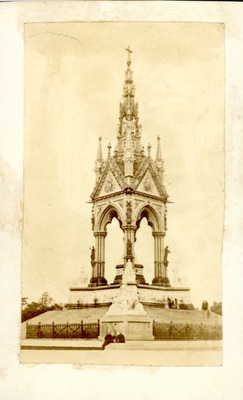
A carte-de-viste historical photograph of the Albert Memorial. The Gothic Revival monument was completed in honor of Prince Albert, consort of Queen Victoria, in 1876.
School of Art/Architecture
Gothic Revival
Digital Date
8-21-2025
Creative Commons License

This work is licensed under a Creative Commons Attribution-NonCommercial 4.0 International License
File Format
image/jpeg

Comments
The Albert Memorial (1872) is a monument built in honor of Prince Albert of Saxe-Coburg and Gotha (1819-1861). The husband of Queen Victoria (1819-1901), Prince Albert was known for being a strong supporter of the arts and sciences. He worked to develop Great Britain and its territories culturally and economically. While public opinion of Prince Albert varied during his lifetime, he was widely mourned after his death in 1861. He is generally remembered as a man who worked for the good of the British people.
Following the death of Prince Albert, Queen Victoria commissioned a national memorial to honor her late husband. The funds to build the memorial were raised by the public, who provided most of the 120,000 pounds (equal to about 10,000,000 pounds in 2010) needed for the construction. The monument was opened to the public in 1872 but was not completed until 1876.
George Gilbert Scott (1811-1878) designed the Albert Memorial. At the time of Prince Albert’s death, Gothic Revival was a popular architectural style. Characterized by intricate details and pointed arches, Gothic Revival was used to tell stories and draw attention from viewers. The style’s pointed arches adorn the Albert Memorial. Intricate scrolls and geometric patterns cover every arch and every stone beam. Corinthian scrolls decorate the tops of the four columns that support the canopy and spire of the monument.
When it was designed, and at the start of its construction, The Albert Memorial fit the public view of what beautiful art looked like. The placement of Prince Albert on a pedestal at the center of the monument serves as a reflection of the “hero” ideal that was common in the Victorian era. However, by the time of its completion, the Albert Memorial had gone out of style. The public had moved on to Renaissance styles and no longer favored the Gothic Revival style of the monument. By the mid 20th century, it was considered an eyesore.
A notable feature of the Albert Memorial is the Frieze of Parnassus which runs around the bottom of the monument’s main pedestal. The frieze depicts well-known figures including Michelangelo and Da Vinci. The main purpose of the relief is to honor Prince Albert’s dedication to the arts and sciences. The figures presented also represent the cultural icons of the general public at the time.
Above Prince Albert’s statue stand the 8 virtues. Faith, Hope, Charity, and Humility stand on the four corners. Prudence, Temperance, Fortitude, and Justice stand in between the others. The inclusion of the virtues, Christian and moral, is a symbol not only of what Prince Albert embodied during his lifetime, but also the life that an ideal royal should lead.
On the four corners surrounding Prince Albert are four groups of figures representing Agriculture, Commerce, Engineering, and Manufactures. The groupings represent areas of importance in Great Britain and symbolize Prince Albert’s efforts to develop the country in multiple facets. Each group of four statues has a standing woman–an allegorical representation of the concept depicted–and three other figures shown either leaning down or kneeling before her.
Farther out on the four corners of the monument are depictions of four continents: Europe, Asia, America, and Africa. The main feature of each sculpture group is a large animal significant to the continent it represents along with symbolic men and women meant to represent the culture of each of the four continents. For Europe, a large cow is shown along with five symbolic European women wearing crowns and long dresses. For Asia, an elephant is depicted alongside five Asian figures. For America, a bison is shown interestingly surrounded by both European and Native American figures, acknowledging the diverse population of North America. For Africa, a camel sits on the ground with an Egyptian-style statue and four African people and one European woman around it.
The Albert Memorial is located in Kensington Gardens, a public park just outside of Kensington Palace. The location of the monument is significant because Prince Albert had a large influence on The Great Exhibition (1851). The exhibition was held in Hyde Park, adjacent to Kensington Gardens. Showcasing mostly British accomplishments in the arts and sciences, the exhibition connected with Prince Albert’s ideas of British cultural advancement. Its grand exhibit hall, the Crystal Palace, stood on the site where the Albert Memorial was later erected.
While never torn down, The Albert Memorial suffered years of neglect due to public indifference. In a campaign funded by the English Heritage Foundation, the monument was restored in the mid 1990s.
Works Cited:
Brooks, Chris. The Prince Consort National Memorial: its History, Contexts, and Conservation. Italy, Conti Tipocolor, 2000, https://annas-archive.org/slow_download/257d5860c687afc6e0a8b67963f7a225/0/0.
Flint, Kate. “Gilbert Scott, The Albert Memorial (1872)”. Victorian Review, Vol. 35, No. 1, 2009, pp. 45-49. https://www.jstor.org/stable/27793697?seq=1.
Hobhouse, Hermione. “The Legacy of The Great Exhibition”. RSA Journal, Vol. 143, No. 5459, May, 1995, pp. 48-52, https://www.jstor.org/stable/41376736?seq=1.
“The Albert Memorial - A 19th Century World View”. A London Inheritance, Dec 15, 2019, https://alondoninheritance.com/tag/albert-memorial/.
Wagner-Wright, Sarah. “The Albert Memorial”. Wagner-Wright Enterprises, Sep 30, 2019, https://www.sandrawagnerwright.com/the-albert-memorial/.