

Monuments Class Projects
Architect/Sculptor of Monument
Jean-Baptiste Lepère (architect) and Jacques Gondouin (architect)
Preview
Medium
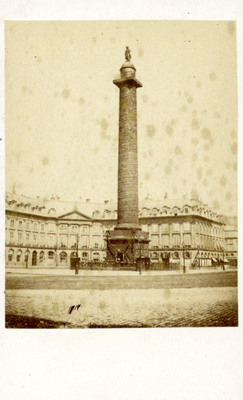
photograph, carte-de-viste
Keywords
Place Vendôme, Grande Armée, Charlemagne, Napoleon, Paris Commune, Neoclassicism, France, French Restoration of 1815, July Monarchy of 1830, Paris Commune of 1871, Bourbon Restoration, Napoleon III, Second Empire of France, 3rd Republic
Physical Dimensions
4 x 2.5 "
Date of Publication
c. 1850-1900
Name of Monument
Vendôme Column
Date of Creation of Monument
8-25-1806
Date of Completion or Dedication of Monument
8-15-1810
City of Monument
Paris
Location within City
Place Vendôme
State/Province of Monument
Ille-de-France
Country of Monument
France
Description
The Vendôme Column is a neoclassic-style column commissioned by Napoleon and based on Trajan's Column. During the 19th century, the statue on top of the column was repeatedly changed: by the Bourbon Restoration in 1814, the July Monarchy in 1833, and the Second Empire of Napoleon III in 1863. The column was destroyed by the Paris Commune in 1871, but restored in 1875.
School of Art/Architecture
Neoclassic Column
Publisher
Collin
Digital Date
8-21-2025
Copyright
Physical copy of the carte-de-viste is in the public domain. Digital copy scanned by Rod Library ©️2025 Rod Library, University of Northern Iowa
Creative Commons License

This work is licensed under a Creative Commons Attribution-NonCommercial 4.0 International License
File Format
image/jpeg
Additional Files
- Stepleton - Vendôme Column Background (2).pdf (90 kB)
Background Information

Comments
Throughout its long history, the Vendôme Column has been known by several names and represented different regimes. Its origin lies in an 1800 decree to honor heroes in major French towns. The Vendôme Column was one of two columns proposed for the city of Paris, and it was to be set in the Place Vendôme. In 1803, Napoleon Bonaparte (1765-1821) confirmed the plans for a column there.
Inspired by Trajan’s Column, the Vendôme Column was designed in the neoclassical style, a late 18th-century and 19th-century Western cultural movement based on the art and architecture of ancient Greece and Rome. The plans originally placed a statue of the Holy Roman Emperor Charlemagne (c. 742-814) on top of the column to show Napoleon’s claim to French imperial legitimacy. After Napoleon’s success at the Battle of Austerlitz, a new plan proposed a dedication to his Grand Armée. Napoleon’s statue would now top the column.
Designed by architects Jean-Baptiste Lèpere (1761-1844) and Jacques Gondouin (1737-1818), part of the materials for the column came from 1200 arterial pieces siezed from Russian and Austrian forces. The monument itself consists of a stone core covered with 425 bronze plaques, and encircled by a 280-metre bas-relief frieze designed by Pierre-Nolasque Bergert (1782-1863). This spiral relief depicts major events of Napoleon’s 1805 campaign. The team of sculptors needed to make it come to life included Bartolini, Boizot, Bosio, Clodion, Corbet, Ramey, Rude, and Ruxthiel. Written on the base of the column was an inscription that translates as “Monument erected to the glory of Napoleon the Great’s Grande Armée, begun on 25 August 1806 and finished 15 August 1810” (Huguenad).
At first, the top of the column showcased a statue of Napoleon in classical Roman garb sculpted by Antoine-Denis Chaudet (1763-1810). After Napoleon’s fall in power in 1814, the statue was removed during the Bourbon Restoration and replaced with a banner of fleurs de lys, a symbol of the French monarchy.
After the July Revolution (1830), a new statue of Napoleon called the “Little Corporal” created by Charles Émile Serre (1798-1858) was added to the top in 1833. This statue was removed by Emperor Napoleon III (1808-1873). In 1863, Napoleon III commissioned a statue of Napoleon in imperial dress to be put back on top of the column. This stood until 1871, when the entire column was toppled by the temporary revolutionary government, the Paris Commune. After the fall of the Commune, the Vendôme Column was re-erected in 1873, and the instigator of the toppling, Gustave Courbet (1819-1877), was ordered to pay for the costs of rebuilding it. A replica of the original statue of Napoleon in Roman garb has since topped the rebuilt column.
The long history of this column shows that each government from Napoleon to the Third Republic used its architecture to bolster their power in Paris. Every change to the column reflected a new French government. Today, it stands as a testament to Napoleon’s imperial ambitions and the multiple political upheavals that shaped 19th century France.