

Monuments Class Projects
Architect/Sculptor of Monument
Josef Ondřej Kranner (Architect, 1801-1871) and Josef Max (Sculptor, 1804-1855)
Preview
Identifier
22a
Medium
photograph, carte-de-viste
Keywords
Emperor Francis I, Prague, Czechia, cartes-de-viste, Emperor, Neo-Gothic, Czech history, fountain, Holy Roman Empire, Austrian Empire
Physical Dimensions
2.9 x 4.5"
Date of Publication
c. 1850 - 1900
Name of Monument
Kranner's Fountain
Date of Creation of Monument
1844
Date of Completion or Dedication of Monument
1850
City of Monument
Prague
Location within City
Park of National Awakening
State/Province of Monument
Bohemia
Country of Monument
Czechia
Description
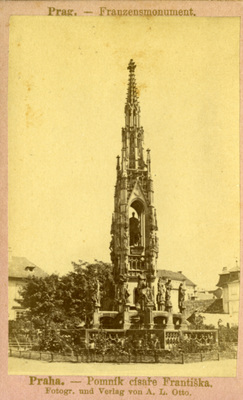
Kranner’s Fountain is a Neo-Gothic monument in Prague, Czechia. It honors Emperor Francis I of Austria, and was created by architect Josef Kranner, whom it is named after. The statue depicts the Emperor in the center aboard a horse, surrounded by statues that represent each region of Czechia, and figures that symbolize areas which serve the well-being of the country like industry, agriculture, art, peace, abundance, mining, trade, and the sciences.
School of Art/Architecture
Gothic Revival
Publisher
A.L. Otto
Digital Date
1-19-2022
Copyright
Physical copy of the carte-de-viste is in the public domain. Digital copy scanned by Rod Library ©2025 Rod Library, University of Northern Iowa.
Creative Commons License

This work is licensed under a Creative Commons Attribution-NonCommercial 4.0 International License
File Format
image/jpeg

Comments
Kranner's Fountain, completed in 1850, commemorates Emperor Francis I of Austria (1768-1835), a Habsburg who ruled over Austria and Bohemia from 1792 to 1835. Francis I was the last of the Holy Roman Emperors, and he became the first Emperor of Austria. During his rule, he oversaw Austria’s participation in and recovery following the Napoleonic Wars. He was a prominent figure who helped the Congress of Vienna restore a balance of power in the Concert of Europe. His subjects considered him a strict monarch who ruled with harsh censorship and a strong police force [5].
This monument was unveiled for public view in 1850. Although the origins of this fountain commemorating Francis date back to 1835, a month after he died, its construction didn’t start until 1844. Kranner’s Fountain is located in a riverside park in the Old Town of Prague, between two important landmarks: the Legion Bridge and Charles Bridge [2].
The style of this monument is a revival of Gothic architecture called Neo-Gothic. Neo-Gothic architecture was a popular style from the mid-18th century until the mid-19th century, when it reached its peak popularity. This monument showcases Gothic features through its four main arches with pointed tops, its looming spire, its many pinnacles, and its intricate details. Kranner's Fountain is named for the architect of this project, Josef Ondřej Kranner (1801-1871) [2]. Josef Kranner was a Czech architect who created other structures and buildings in the Neo-Gothic style. The sculptor for Kranner’s Fountain was Josef Max (1804-1855), who also worked on other important sculptures in Prague [2].
This monument has several important features. On its lower tier, sixteen statues on small pillars represent each historic region of Czechia (which was known as Bohemia when the monument was created). These regions include Beroun, Boleslav, Budějovice, Bydžov, Čáslav, Chrudim, Hradec, Klatovy, Kouřim, Litoměřice, Loket, Plzeň, Prácheň, Rakovník, Tábor and Žatec [4]. Also in the lower tier, a statue of a woman holding a shield represents the city of Prague [2]. On the upper tier, eight figures represent industry, agriculture, art, peace, abundance, mining, trade, and the sciences. Finally, the main focus is in the center of the fountain: an equestrian statue depicting Francis I [3].
The equestrian statue of Emperor Francis I of Austria has undergone some interesting changes throughout the history of Kranner’s Fountain. It went missing from the monument for almost a century. In 1918, the equestrian statue was removed from the monument and placed in the National Museum's Lapidarium [1]. It was taken down following the Declaration of independence for Czechoslovakia when the Austro-Hungarian Empire disbanded following the end of World War I. The Czech people wanted this part of the monument gone, as they thought it was a symbol of oppression and an external imperial power [2]. However, in 2003, a replica of the original statue was created and returned to the fountain, following a restoration of the monument. The original statue can still be found in the National Museum's Lapidarium today.
Bibliography:
[1] Alex. (2014, February). Smetanovo nábreží: Monument to František I — The Prague Vitruvius. The Prague Vitruvius. https://pragitecture.eu/smetanovo-nabrezi-monument-to-emperor/
[2] Free Walking Tour Prague. (2018). Free Walking Tour Prague. https://freewalkingtourprague.eu/blog/kranners-fountain
[3] Kranner’s Fountain, Prague. (2025). Aviewoncities.com. https://aviewoncities.com/prague/kranners-fountain
[4] Pánek, J., & Tůma, O. (2018). A history of the Czech lands / Jaroslav Pánek, Oldřich Tuma. (Second edition.). Charles University, Karolinum Press, 2018.
[5] The Editors of Encyclopaedia Britannica. (n.d.). Francis II | Biography & Facts | Britannica. Www.britannica.com. https://www.britannica.com/biography/Francis-II-Holy-Roman-emperor