

Monuments Class Projects
Architect/Sculptor of Monument
John Henry (Unknown) John Smyth (1776-1840)
Preview
Medium
photograph, carte-de-viste
Keywords
Anglican priest, George Walker, Pillar, Londonderry, Northern, Ireland, 1828, Protestantism, Catholicism, Siege of Londonderry, James II, 1688, Williamite War, Irish Republican Army, Bombing, 1973, Northern Ireland Troubles
Physical Dimensions
2 1/2 x 4 1/4 ''
Date of Publication
c. 1860-1900
Name of Monument
George Walker's Pillar
Date of Creation of Monument
1828
Date of Completion or Dedication of Monument
1828
City of Monument
Londonderry, Derry
Location within City
City Walls
State/Province of Monument
Londonderry
Country of Monument
Northern Ireland, United Kingdom
Description
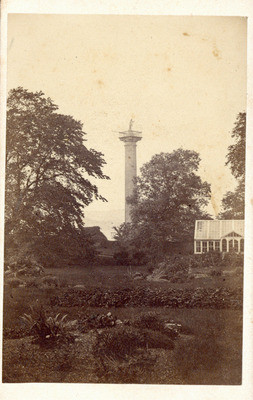
Walker’s Pillar was erected in 1828 to honor Reverend George Walker for his leadership during the Siege of Londonderry (1689). During the Troubles, the pillar was blown up by the Irish Republican Army (IRA) in 1973. Only the restored base remains on site today. A replica of Walker’s statue is now in the garden of the nearby Apprentice Boys Memorial Hall. The pillar originally stood about 80 feet to 100 feet tall. Walker’s statue on top depicted him holding a Bible in his right hand with his left hand pointing towards the Foyle River.
School of Art/Architecture
Classical Revival/Doric Column
Publisher
Ayton, Photographer, Londonderry
Digital Date
Summer 8-21-2025
Copyright
Physical copy of the carte-de-viste is in the public domain. Digital copy scanned by Rod Library ©2025 Rod Library, University of Northern Iowa
Creative Commons License

This work is licensed under a Creative Commons Attribution-NonCommercial 4.0 International License
File Format
image/jpeg

Comments
Walker’s Pillar was a monument to the joint Governor of Londonderry, Northern Ireland, Rev. George Walker (1645-1690), who was also an Anglican minister. The base of the pillar was built in 1826 on the city walls. The pillar was designed by architect John Henry, and the statue of Walker was made by the sculptor, John Smyth (1776-1840). The column and statue were erected in 1828. This monument commemorated Walker’s courage and leadership during the Siege of Londonderry (1689). The base of the monument has an inscription honoring George Walker for leading the people of Londonderry against the Catholic monarch James II (1685-1688). The statue on top of the 80-100 foot pillar showed Walker holding a bible in one hand while pointing off into the distance with the other.
The Siege of Londonderry was a pivotal event in the Williamite War (1689-1691). This war was between the Williamites, supporters of Protestant William III (1688-1702), and Jacobites, supporters of James II (1685-1688). During the Siege, Jacobites tried to force their way into the walled protestant city of Londonderry but were refused entry by the Apprentice Boys, who closed the gates. Its citizens continued to refuse even when James II showed up demanding their surrender. After this, Londonderry was bombarded, and a blockade was set up against them. During this time, George Walker stepped up and rallied an army of up to 20,000 men, and encouraged the city to never surrender or give in to the Jacobites. Many citizens died either by starvation or combat. The siege became a symbol of Protestant resistance to Catholic forces. They were successful, as a ship carrying supplies was able to break through the blockade after five months, and the siege ended.
During the Northern Ireland Troubles, this monument was blown up by the Irish Republican Army (IRA) in 1973, due to it commemorating ongoing Protestant domination in the North. The base of the monument remains in the original location, and a copy of the George Walker statue that used to sit at the top of the pillar now stands in the nearby garden of the Apprentice Boys Memorial Hall. There has been a discussion of restoring the monument, but it is quite complicated by the immense size of the original monument, along with dissension over its symbolism of Protestant rule over Catholics until recent years. Penal Laws were imposed on Catholics in the years following the Williamite War, which imposed heavy restrictions and segregation, as well as economic and social exclusion, political disenfranchisement, and religious suppression. These continued until after the modern Troubles ended in the 1990s.