

Monuments Class Projects
Architect/Sculptor of Monument
Apollodorus of Damascus (c. 60-130 CE)
Preview
Medium
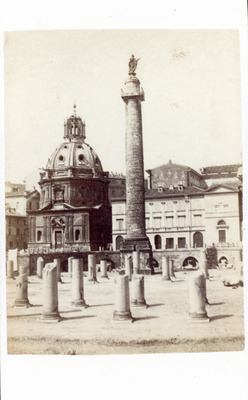
photograph, carte-de-viste
Keywords
Dacian Wars, Emperor Trajan, Rome, Italy, history, Roman Empire, Europe, Apollodorus of Damascus, St. Peter, frieze
Physical Dimensions
3.75 x 2.375”
Date of Publication
Unknown
Name of Monument
Trajan's Column
Date of Completion or Dedication of Monument
113
City of Monument
Rome
Location within City
Piazza del Foro di Traiano
State/Province of Monument
Lazio
Country of Monument
Italy
Description
Trajan’s Column in Rome, was constructed to honor Emperor Trajan’s victory in the Dacian Wars. The column was designed and constructed by Apollodorus of Damascus (c. 60-130 C.E.). The monument is 126 feet tall and has a frieze with intricate carvings to depict events during the war.
School of Art/Architecture
Roman/Classical
Publisher
c. 1860-1900
Digital Date
8-21-2025
Copyright
Physical copy of the carte-de-visite is in the public domain. Digital copy scanned by Rod Library ⓒ2025 Rod Library, University of Northern Iowa
Creative Commons License

This work is licensed under a Creative Commons Attribution-NonCommercial 4.0 International License
File Format
image/jpeg

Comments
Trajan’s Column, one of the best preserved ancient monuments in Rome, commemorates the victory of Roman Emperor Trajan (reigned from 98-117 CE) in the Dacian Wars (101-102 and 105-106 CE). Victory in these wars helped to secure the empire’s borders and establish the Empire’s power and strength. The column was built in Rome, the capital of the Roman Empire. It was erected between the years 106-113 CE by Apollodorus of Damascus (c. 60 -130 CE), a Greek architect and engineer, who also designed many other important buildings for Trajan. In 1999, architect Lynne Lancaster did a reconstruction of the column, to learn more about the process of building it. It took complex designing and engineering, and would have required complex lifting devices, careful planning, and precise execution, due to the complexity and intricacy of the designs on the frieze surrounding the column. The monument is made of fine grained Luna marble which is what allowed for intricate designs to be carved because of the material’s durability and high quality. The column stands 126 feet tall and includes a tomb chamber at the base for Emperor Trajan’s ashes, as well as a spiral staircase on the inside. Wrapped around the column, a 190-meter-long frieze displays images from the wars to convey stories, from the preparations through the final battles. It contains 155 scenes and over 2,600 carved figures. The stories told in these reliefs contain no words, which allowed it to be accessible for those who were illiterate so everyone could understand what the monument was meant to convey. It is thought that the column was originally painted in bright colors, but the paint has since washed away. When the column was built, a bronze eagle was placed upon the top of the column, but after Trajan’s death, the eagle was replaced with a bronze statue of him. In 1588, Trajan’s statue was replaced with a statue of St. Peter. On the base, there is an inscription dedicated to Emperor Trajan. The translated inscription reads: “The Senate and People of Rome [dedicate this] to the emperor Caesar, son of the divine Nerva, Nerva Trajan, Augustus, Germanicus, Dacicus, Pontifex Maximus, holding tribunician power for the 17th time, acclaimed imperator 6 times, consul 6 times, father of the fatherland, to demonstrate to what great height the hill and place was removed for such great works,” (“Column”).
Roman architecture at the time of Trajan’s Column was unlike anything else that had come before it. Romans took inspiration from the Greeks, Etruscans, and a few other groups, yet Roman architecture differed drastically because of the discovery of and experimentation with concrete, arches, and vaulting. Due to these architectural advancements, the Romans were able to create new and unique interior structures and designs. They began to focus on the design and aesthetic of the interior of buildings rather than filling rooms with structural support, allowing Roman buildings to be striking since both the exterior and now interior were well designed. Roman cities also focused on surrounding monument structures with important buildings so they were useful meeting places for town councils. Originally, the column stood in the middle of a courtyard surrounded by a market, important buildings, and galleries with various heightened levels for a variety of viewpoints of the column. However, the galleries have since fallen or been destroyed, but the column remains in the same place.