

Monuments Class Projects
Architect/Sculptor of Monument
Unknown
Preview
Medium
photograph, carte-de-viste
Keywords
Equestrian Statue of Marcus Aurelius, Rome, Italy, Piazza del Campidoglio, Capitoline Museum, emperor, history – Europe – Central Western, cartes-de-visite (card photographs), equestrian statues, Marcus Aurelius, Roman/Classical sculptures, Italy, Marcomannic Wars, Michelangelo, Roman Empire.
Physical Dimensions
4 x 2 5/16"
Date of Publication
c. 1867-1874
Name of Monument
Equestrian Statue of Marcus Aurelius
Date of Creation of Monument
176
Date of Completion or Dedication of Monument
180
City of Monument
Rome
Location within City
Piazza del Campidoglio/Capitoline Museum
State/Province of Monument
Lazio
Country of Monument
Italy
Description
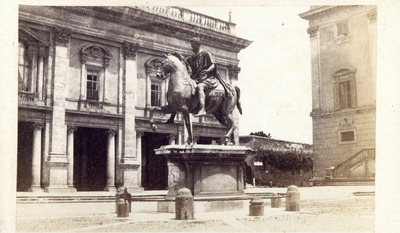
This carte-de-visite photograph depicts the Equestrian Statue of Marcus Aurelius. The Classical statue was created to honor the Roman Emperor Marcus Aurelius for his triumph in the Marcomannic Wars in c. 175 – 176 C.E. It was moved into the Capitoline Museum in 1981 and replaced by a replica due to corrosion.
School of Art/Architecture
Roman/Classical
Publisher
Sommer and Behles Photographes
Digital Date
Summer 8-21-2025
Copyright
Physical copy of the carte-de-viste is in the public domain. Digital copy scanned by Rod Library ©2025 Rod Library, University of Northern Iowa.
Creative Commons License

This work is licensed under a Creative Commons Attribution-NonCommercial 4.0 International License
File Format
image/jpeg
File Size
https://scholarworks.uni.edu/his_monuments_sp2022/148/

Comments
This statue commemorates Marcus Aurelius (121-180 C.E.) for his triumph over the Germanic tribes, which helped Rome maintain its territorial security by preventing further invasions. It also commemorates Marcus Aurelius’s effective military strategy. The monument was erected after Marcus Aurelius’s victory in 176 C.E., but the sculptor who made it is unknown.
Its design used an ancient Roman portraiture or a lost wax method of casting, where the sculptor makes wax molds of the statue and then pours molten bronze into them to create the pieces. The pieces are then soldered together and gilded with gold to create the final statue. Marcus Aurelius’s horse is presented with bulging muscles, flaring nostrils, and in a trotting position which brings a life-like appearance to it, showing him riding a powerful and loyal stead. Another significant detail is how Marcus Aurelius’s hand is stretched out to acknowledge a crowd of subjects. Some historians believe it is stretched out to show mercy towards his vanquished opponents. He also wears Roman sandals called “calcei patricii” which were popular throughout the empire at the time.
An inscription was put on the base of the statue in 1538 when Pope Paul III had it moved to the Capitoline Hill, but this description was later removed. A newer description was added in 1981 explaining who Marcus Aurelius was, when he ruled and what he did as ruler, as well as when the original statue was moved to the Capitoline. The statue was originally located in the Lateran in Rome. It was moved to the Capitoline Hill in 1538, after Pope Paul III (1468-1549) commissioned Michelangelo (1475-1564) to move it from Lateran to the newly designed Piazza del Campidoglio. The Capitoline Hill was the center of ancient Rome, where the Temple of Jupiter Optimus Maximus stood and where Roman triumphal processions ended. Michelangelo wanted to use the statue as the centerpiece of his Piazza del Campidoglio.
It stayed here until 1981 when it was moved to the Capitoline Museum to prevent it from corroding any further. An identical replica was then made and placed on the marble pedestal in the center of Piazza del Campidoglio. During the Middle Ages many Roman statues were melted down, but the Marcus Aurelius statue survived because it was thought to depict Constantine, who was revered as first Christian Emperor of Rome. By the Renaissance, the Marcus Aurelius Statue was recognized as a great work of classical sculpture and became widely admired. To this day, it remains one of the greatest works of art from ancient Rome.