

Monuments Class Projects
Architect/Sculptor of Monument
Unknown
Preview
Medium
photograph, carte-de-viste
Keywords
Emperor, Commodus, Piazza Colanna, Campus Martius, rain miracle, marble, bronze, Germanic, Sarmatian, Quadi, Domenica Fontana, St. Paul, Sixtus, Five Good Emperors of Rome
Physical Dimensions
2.5 x 4"
Date of Publication
c. 1850-1900
Name of Monument
Column of Marcus Aurelius
Date of Creation of Monument
193
Date of Completion or Dedication of Monument
193
City of Monument
Rome
Location within City
Piazza Colonna
State/Province of Monument
Lazio
Country of Monument
Italy
Description
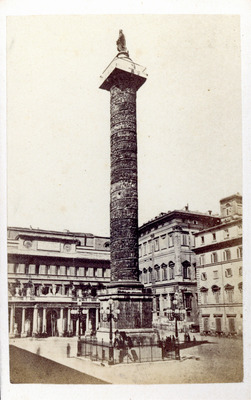
Located in the Piazza Colonna, in the heart of Rome, the Column of Marcus Aurelius is constructed of marble reliefs upon a 12-meter base. Winding around the exterior of the column, these reliefs depict the military accomplishments of Marcus Aurelius, the last Emperor of Rome during the Golden Era. It was originally completed in 193 C.E. under his son, Emperor Commodus. The column’s base was later reconstructed in 1589, when a bronze statue of St. Paul was placed on top. The spiral staircase in the interior of the Column originally could be ascended, but it has long been sealed up.
School of Art/Architecture
Roman/Classical
Publisher
Unknown
Digital Date
Summer 8-21-2025
Copyright
Physical copy of carte-de-visite is in the public domain. Digital copy scanned by Rod Library ©2025 Rod Library, University of Northern Iowa
Creative Commons License

This work is licensed under a Creative Commons Attribution-NonCommercial 4.0 International License
File Format
image/jpeg

Comments
The Column of Marcus Aurelius commemorates the last of the “Five Good Emperors of Rome”, Marcus Aurelius (121-180 C.E.). Marcus Aurelius reigned as emperor following the death of Antoninus Pius in 161 C.E. until his own death. The “Five Good Emperors” refers to an era of prosperity, thriving government, and generally peaceful status that the Roman Empire saw during this period. Following Marcus Aurelius’ death, the era soon came to an end and the empire fell into civil war.
The monument’s construction was commissioned by the Roman Senate either during his life, around 176 C.E., or following his death in 180. While the original inscription has been destroyed, a later inscription confirms that its construction was completed in 193 C.E. by workers under Marcus Aurelius’ son and successor, Commodus (161-192 C.E.). Commodus was the first co-emperor of Rome, reigning alongside his father beginning in 177. He became the sole emperor after Aurelius’ death in 180. Commodus’ reign is generally considered to be the end of the era of prosperity and peace in the Roman Empire.
Today, the column stands in Piazza Colonna in the heart of Rome, less than 500 meters away from the older Trajan’s Column, the imperial column that inspired the Column of Marcus Aurelius and had been constructed earlier in the same century. Within Ancient Rome, Marcus Aurelius’ Column was located in Campus Martius, a public area filled with temples, places of worship, monuments, bath houses, and theaters.
The column itself was constructed to a height of 100 Roman feet (equal to 30 meters), and it stands upon a twelve meter base. While the column has largely remained in its original state since its construction in the 2nd century, the base was decorated and restored by Italian architect Domenico Fontana (1543-1607) in 1589, as commissioned by Pope Sixtus V (1521-1590). Fontana was commissioned by Sixtus to help design many Roman landmarks that still exist today, including parts of St. Peter’s Basilica, the Vatican Library, and the Lateran Palace.
The design of the column is constructed out of a spiraling stack of 28 cylinders made of white Carrera marble, which are each carved with scenes of Marcus Aurelius’ military campaigns and successes against the Germanic and Sarmatian tribes. The reliefs were intended to be read from the bottom up to tell a complete narrative of his military expeditions, showing off many of his speeches, battles, marches, and more. Famously, it displays the “rain miracle”, when Marcus Aurelius’ legion was surrounded by Quadi rivals in what is today Czechia and was nearly forced to surrender due to lack of water, only to be saved by the “miracle” of a heavy downpour.
Along with the restoration of the base in the 16th century, two other alterations were made to the monument at the same time. Initially, the spiral staircase that occupied the interior of the column, through the center of the marble blocks, could be ascended, but it has been sealed for preservation purposes so that the column can now only be viewed externally in Piazza Colonna. Additionally, a bronze statue of Saint Paul, sculpted by Tommaso della Porta in 1588, was placed atop the column at the same time as the restoration of the base. Before this, the column was originally topped by a statue of Marcus Aurelius himself. While it is recorded that the original statue had been lost by the time of the restoration, the choice to not replace it with a similar or identical statue to the original was an attempt to Christianize the column and its perception; a statue of Saint Peter had been placed upon Trajan’s Column the previous year. Marcus Aurelius himself had not been a Christian, and the choice to replace his statue with Paul aligns with broader efforts by Pope Sixtus V to show papal power throughout the city.