

Monuments Class Projects
Architect/Sculptor of Monument
Unknown
Preview
Medium
photograph, carte-de-viste
Keywords
Augustus, Prima Porta, Augustus of Prima Porta, Livia, Roman Empire, Italy, Parian marble, Portrait statue, Roman emperor, Vatican Museum, Roman mythology/gods
Physical Dimensions
2 5/8 x 4"
Date of Publication
c. 1860 - 1900
Name of Monument
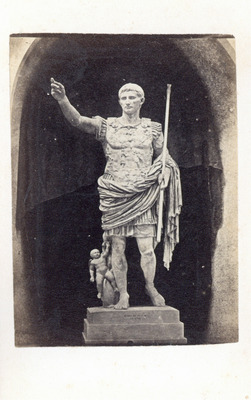
Augustus of Prima Porta Statue
City of Monument
Rome
Location within City
Braccio Nuovo, Vatican Museum
State/Province of Monument
Lazio
Country of Monument
Vatican City
Description
The Augustus of Prima Porta is a marble statue of Augustus, the first Roman Emperor (reigned 27 B.C.E. - 14 C.E.). It was originally discovered in 1863 at the Villa of Livia in Prima Porta in Rome. Carved from white Parian marble, the statue stands over two meters tall and is thought to be a replica of a lost bronze original. Symbolic elements, such as the adorned breastplate and the traditional contrapposto pose, are used to honor Augustus's authority, military victories, and divine heritage. The statue is now housed in the Vatican Museum.
School of Art/Architecture
Roman Imperial/Classical
Publisher
Unknown
Digital Date
8-21-2025
Copyright
Physical copy of the carte-de-visite is in the public domain. Digital copy scanned by Rod Library ©2025 Rod Library, University of Northern Iowa.
Creative Commons License

This work is licensed under a Creative Commons Attribution-NonCommercial 4.0 International License
File Format
image/jpeg

Comments
The Augustus of Prima Porta statue depicts Augustus Caesar (reigned 27 B.C.E.- 14 C.E.), the first Roman Emperor. It was discovered in 1863 in the ruins of the Villa of Livia in Prima Porta, a zone in northern Rome. Carved from white Parian marble, it is more than two meters tall and thought to be a replica of a lost bronze original. The statue honors Augustus’ authority and ideology by portraying him as an emperor and triumphant leader. It is thought that Livia Drusilla, Emperor Augustus' third wife, commissioned the marble statue by an unknown sculptor. It is suggested that the commissioning took place between 20 B.C.E. and 29 C.E. The original statue was believed to have been completed before Livia died in 29 C.E. to celebrate her husband's victory over the Parthians in 20 B.C.E.
The sculpture was made as political propaganda in the early years of Augustus Caesar's reign, which ran from 27 B.C.E. until his death in 14 C.E. The Parian marble statue commemorating Augustus depicts him in a classical Greek pose known as contrapposto, in which the weight rests on one leg while the other is relaxed, allowing the shoulders and arms to be off-axis of the hips and legs. This stance creates a natural balance between the upper and lower body, symbolizing harmony and control. The statue holds historical significance because it illustrates how Augustus utilized art to disseminate propaganda. He is portrayed as a strong warrior and a leader who is intimately associated with the gods. This illustrates how Augustus’ empire was idealized and seen as youthful and flawless, rather than his actual appearance. His function as the agent of peace and prosperity in the Roman Empire is further supported by the breastplate's imagery, which features gods and figures that symbolize conquered territories during his reign.
The statue commemorating Augustus is much more than just a realistic portrayal of the first emperor. His reign is commemorated, including his military victories and the ideals he sought to uphold, while it also highlights his divine lineage. His individual accomplishments, including his naval triumph at Actium and his recovery of the Roman standards from the Parthians, are also honored in the sculpture. A Cupid figure riding a dolphin is shown next to his right leg to symbolize his divine ancestry through the goddess Venus and his naval triumph at the Battle of Actium in 31 B.C.E. In addition to this, a scene on the breast plate depicts a Roman and Parthian figure returning a standard following his diplomatic victory over the Parthians. In keeping with the Roman Imperial style, the breastplate's representation, along with other components, conveys strength and dignity, serving as a form of political propaganda. The heritage and power of Augustus as emperor are communicated through these symbolic details. To further indicate divine favor and his association with the gods, the breastplate also features images of Apollo and Diana, Pax (the goddess of peace and the female personification of Pax Romana), the earth goddess Tellus, and the sun and sky gods Sol and Caelus. Together, the symbolic details highlight Augustus’ authority, divine ancestry, and role as both warrior and peacemaker. Hence, Augustus’ success as a warrior and ruler is emphasized throughout the sculpture's carvings.
Dated to the first century C.E., the Augustus of Prima Porta was originally rediscovered in 1863 at the home of his wife, Livia Drusilla, the Villa of Livia, located in Prima Porta, a northern suburb of Rome. It is displayed in the Vatican Museum today, where the statue is preserved as an important work of Roman imperial art. The statue's purpose has changed from being an instrument of imperial propaganda to an educational and cultural artifact with its move from a private villa to a museum gallery. Its placement in the museum emphasizes its artistic and historical significance, enabling viewers to examine the sculpture's symbolic meanings as well as an original depiction of the first Roman emperor.