

Monuments Class Projects
Architect/Sculptor of Monument
Rabirius (not confirmed)
Preview
Medium
photograph, carte-de-viste
Keywords
Roman Empire, Forum, Fall of Jerusalem, Triumphal Arch, Domitian, Menorah, 1st Jewish-Roman War, Jerusalem Temple
Physical Dimensions
4.25 x 2.47"
Date of Publication
c. 1850-1900
Name of Monument
Arch of Titus
City of Monument
Rome
Location within City
Via Sacra/Forum
State/Province of Monument
Lazio
Country of Monument
Italy
Description
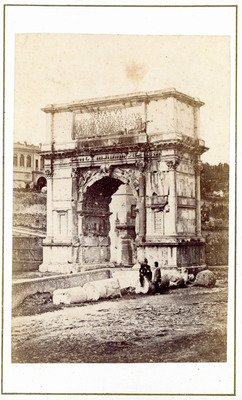
This carte-de-visite photograph shows the Arch of Titus, a Roman triumphal arch built around c. 81 C.E. To honor Emperor Titus and the Fall of Jerusalem. One of its reliefs depicts the spoils from the Jewish Temple taken during the 1st Jewish-Roman War.
School of Art/Architecture
Roman/Classical
Publisher
Unknown
Digital Date
8-21-2025
Copyright
Physical copy of the carte-de-viste is in the public domain. Digital copy scanned by Rod Library ©2025 Rod Library, University of Northern Iowa.
Creative Commons License

This work is licensed under a Creative Commons Attribution-NonCommercial 4.0 International License
File Format
image/jpeg

Comments
The Arch of Titus was built to commemorate the life and military achievements of Emperor Titus Flavius Vespasianus (reigned 79-81 C.E.). More specifically it commemorates the Roman victory in the First Jewish-Roman war fought in 66-70 C.E. , Which culminated with the fall of the Second Temple in Jerusalem in 70 C.E. Not only does it celebrate Emperor Titus but the victory he shared with his father Emperor Vespasian. This was a crucial victory for the Flavian dynasty, Vespasian, Titus, and Domitian (who created this arch). The destruction of the Temple in Jerusalem was a monumental event that marked a turning point for the Jewish faith leading to a shift to rabbinical tradition. For the Romans, it reinforced their power and control over the empire.
A lot of documentation about the design is lacking, yet some scholars have made connections to Rabirius. He was the emperor Domitian’s favorite architect, who is sometimes credited with designing the Colosseum. This arch became a model for other triumphal arches around the Roman Empire as well as in the modern era. This period in the Roman Empire saw the consolidation of imperial power and a turn towards military prowess and a deified emperor. The arch not only commemorates the emperor, but is also a piece of imperial propaganda. It cements the Flavian authority that was established by military success.
The most important features of the arch are the two main reliefs on its interior. The Spoils of Jerusalem Relief depicts Roman soldiers carrying off the vessels from the Jerusalem Temple including the menorah, table of the showbread, and silver trumpets. Opposite the other relief shows Titus, in triumph, riding in a chariot while being crowned by the winged goddess Victory and led by the goddess Valour. It also includes the Roman senate and people of Rome. The central relief depicts the apotheosis of Titus, who is shown ascending to heaven on the back of an eagle. The main inscription spells out “Senatus Popolusque Romanus Divo Tito Divi Vespasiani F. Vespasiano Augusto,” meaning: “The Senate and People of Rome, to the divine Titus, son of the divine Vespasian, Vespasian Augustus.”
The arch has undergone a couple of major changes throughout its history including being part of a medieval fortification when the Frangipani Family incorporated the arch into their fortified tower. This preserved the inner reliefs, but led to the loss of its outer sculptural decoration. Later in the 19th century, the arch was in an almost completely ruined state, but it went under a major restoration commissioned by Pope Pius VII (reigned 1800-23). Giuseppe Valadier (1262-1839) was the architect who worked on this project using travertine to restore it, which can be easily distinguishable from the original marble.