

Monuments Class Projects
Architect/Sculptor of Monument
Baron Carlo Marochetti (1805-1867)
Preview
Medium
photograph, carte-de-viste
Keywords
Memorial Well, Cawnpore India, Indian Mutiny 1857 Memorial Well, Baron Carlo Marochetti, Cawnpore, India, Angel Statue, Cawnpore Massacre, Kanpu, Bibi Ghar Massacre, Angel of the Resurrection, Bibi Ghar Well, Bibighar
Physical Dimensions
2.9 by 3.8
Date of Publication
c.1867-1900
Name of Monument
The Memorial Well
Date of Creation of Monument
1865
Date of Completion or Dedication of Monument
1866
City of Monument
Cawnpore
Location within City
Nana Rao Park, Kanpur
State/Province of Monument
Uttar Pradesh
Country of Monument
India
Description
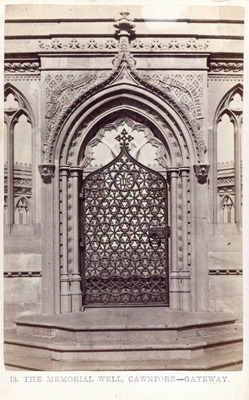
This carte de visite photograph shows the Gothic Iron Gate provided the entrance through the gothic wall surrounding the memorial site. The monument was put up to commemorate the burial of over a hundred British women and children who died during the Indian Mutiny of 1857. The Memorial Well was put up in 1866. Both the Angel and the Memorial Well were later removed. The land where the Well stood was turned into a park, and the Angel and wall was placed at a nearby church.
School of Art/Architecture
Neo- Classical
Publisher
c.1866-1900
Digital Date
Winter 12-4-2025
Copyright
A physical copy of the Carte De Visite is in the public domain. Digital Copy Scanned by Rod Library c.2025 Rod Library, University of Northern Iowa.
Creative Commons License

This work is licensed under a Creative Commons Attribution-NonCommercial 4.0 International License
File Format
image/jpeg

Comments
The Memorial Well in Cawnpore India was a place of beauty created out of tragedy. The monument was created to honor those who died during The Cawnpore Massacre in 1857. After Indian independence the memorial became controversial and was eventually removed.
The Memorial Well in Cawnpore India had two major structures. The Memorial Well had a grand entrance known as “The Gateway” led through the surrounding wall to the sculpture of an angel located at the center. Ground for the monument was broken in 1865, and it was completed in 1866. The sculpture as a whole was created by Baron Carlo Marochetti. Marochetti (1805-1867). Marochetti was an Italian sculptor who worked across Europe and created public sculptures in the Neo-Classical style, in bronze and marble. Marochetti became very well-known and one of his best-known sculptures was The Angel of the Resurrection at the Memorial Well.
The Memorial Well commemorates the 120 British women and children who were massacred at Cawnpore and their bodies thrown into a well, on this site. The Cawnpore Massacre was part of the Indian Mutiny which began in 1857 and went until 1859. On June 6, 1857, after holding out for twenty days, the nine-hundred British men and women in Cawnpore surrendered under false pretenses believing they were being brought to safety. While attempting to depart, a majority of the male population was murdered or shot at a later time. Following this most of the women and children returned to Cawnpore as captives. Eventually after being held captive, the women and children were executed, and their bodies were thrown into a large open well. The massacre received a great deal of negative press across the British Empire.
On the site of this burial, The Memorial Well was built in Cawnpore. The memorial site containing the Well, marked by The Angel of Peace, had originally begun construction in 1865. The exterior to the Memorial Well was a Gothic structure with an iron gate. The gate was in a Gothic screen wall that enclosed the memorial area. The wall to the Memorial Well contained lancet windows and eight finials. The well itself was filled in and topped with the marble statue. The statue, known as The Angel of Peace, is in the Victorian and Neo-Classical style. The Memorial Well was a symbol of mourning and the sacrifices of an empire. The memorial served to commemorate the atrocities committed against the British people during the Mutiny.
The Angel Statue was eventually moved to the Anglican Memorial Church at Kanpur. This removal happened following India's independence in 1947 after the statue was damaged during independence celebrations. The Memorial Well itself was removed and the land was repurposed as Nana Rao Park. The Memorial Well in Cawnpore India was a monument built to honor the innocent people who had lost their lives during a tragic event. Out of tragedy rose something beautiful. The monument became a place for those who lost a relative to remember their lives. However, its purpose was to commemorate British losses during an Indian revolt and so the Memorial Well and Angel were removed once India became an independent nation.