

Monuments Class Projects
Architect/Sculptor of Monument
Martin Desjardins (1637-1694), replica; François-Frédéric Lemot (1772-1827)
Preview
Medium
photograph, carte-de-viste
Keywords
Louis XIV, Bourbon kings, equestrian statue, Baroque sculpture, France, French Revolution, French Restoration, Lyon, 1694, 1715, 1825, history – Europe – Western
Physical Dimensions
4 x 2.5"
Date of Publication
c. 1860-1900
Name of Monument
Louis XIV Statue, Lyon
Date of Creation of Monument
1694
Date of Completion or Dedication of Monument
1825
City of Monument
Lyon
Location within City
Place Bellecour
State/Province of Monument
Auvergne Rhône-Alpes
Country of Monument
France
Description
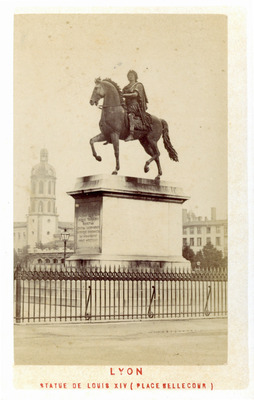
Originally put up in 1715, this statue of the “Sun King” was torn down during the French Revolution in 1793. In 1825, it was recast and restored during the Bourbon Restoration, and since then has remained in Lyon’s main square.
School of Art/Architecture
Baroque Sculpture
Publisher
B. Treille
Digital Date
Summer 8-21-2025
Copyright
Physical copy of the carte-de-visite is in the public domain. Digital copy scanned by Rod Library ©2025 Rod Library, University of Northern Iowa
Creative Commons License

This work is licensed under a Creative Commons Attribution-NonCommercial 4.0 International License
File Format
image/jpeg

Comments
The statue of Louis XIV found in Lyon commemorates Louis XIV (1638-1715) of France, also known as the “Sun King”, who ruled from 1643 to 1715. He essentially ruled with absolute authority, and was unpopular during his reign due to the forced conversion of Protestants[2], and his maintaining an incredibly lavish lifestyle while the peasants of France starved. This statue was originally commissioned when its location, Place Bellecour (the city square of Lyon) was renamed Place Royale in an effort to impress the royal ego. This was also thanks to the king allowing the city to have more land allocated to it. The statue was melted down for military supplies during the French Revolution in the 1790s, as were almost all statues of monarchs at the time. In 1825, during the Bourbon Restoration, an almost identical statue was made and placed back into the square as France revived its royal history.
The original monument was created by Martin Desjardins (1637-1694), a well-known Parisian sculptor. The statue was completed in 1694. Tragically, Desjardins passed away before the casting was finished, causing the statue’s transportation to be delayed by several years. The heavy weight of the statue, along with other complications, caused its transport to take seven years. When it was erected in late 1713, the statue was unbalanced and could not stand upright. They brought in Guillaume Coustou (1677-1746), a popular sculptor of the time, to create a base for the statue. This was finished in 1715, finally allowing the effigy to stand. It remained there for three-quarters of a century before being toppled in 1793 and melted into cannonballs for the revolutionaries. The base remained nearly untouched.
The Bourbon Restoration following Napoleon’s fall saw many statues of Bourbon kings replicated and put back up. In this case, the replica was created in 1825 by François-Frédéric Lemot (1772-1827) who was from Lyon but sculpted it in Paris. The transportation was much easier this time, taking only twelve days by land. Though the original statue was destroyed, the base was still Coustou’s original, allowing for Lemot’s creation to be put up without problem.
The style of this monument is Baroque in its almost dramatic representation of the monarch. Both Desjardins and Coustou were well known for their flattering statues of Bourbon kings. This one in particular is reminiscent of a military victory with the horse trotting at a reasonable pace and the Sun King sitting straight up. The king is also wearing Roman-style armor and has a laurel wreath on his head, signifying victory and accomplishment.
The base of the statue has a simple inscription reading, “Louis XIV, Roi de France, 1638-1715.”[5] The inscription is above a smaller effigy of two nude women lying down with a lion. This part of the statue survived the original’s destruction, being hidden away nearby in the Hôtel de Ville. The women are personifications of the Rhône and Saône rivers which meet in Lyon.
This statue is located in Lyon mostly due to the city’s role as an economic powerhouse during the 18th and 19th centuries. The city dates back to the Roman Empire when Lyon was the capital of the Gaul province. Additionally, it has an incredibly rich gastronomic history. The statue’s location in the central square ensured that more people saw and viewed the Sun King as a regal, powerful, and impressive ruler.