

Monuments Class Projects
Architect/Sculptor of Monument
Sir Christopher Wren (architect, 1632-1723), John Bushnell (1636-1701)
Preview
Medium
photograph, carte-de-viste
Keywords
Art, London, English Baroque, Temple Bar, Temple Bar Gate, Gates of London, Christopher Wren, Great Fire of London, London City Wall, The City, James I, Anne of Denmark, Charles I, Charles II, Executions, Paternoster Square
Physical Dimensions
4 1/16 x 2 1/2"
Date of Publication
c. 1850-1878
Name of Monument
Temple Bar Gate
Date of Creation of Monument
1672
Date of Completion or Dedication of Monument
1672
City of Monument
The City of London
Location within City
Previously Temple Bar, now Paternoster Square
State/Province of Monument
London
Country of Monument
England, United Kingdom
Description
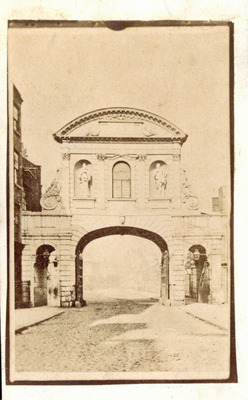
This carte-de-visite photograph shows the Temple Bar Gate in London. The gate allowed entrance through the defensive walls surrounding the medieval city. Originally completed in 1672, the gate was taken down in 1878 and reconstructed in a different location. In 2004, the gate was moved back into the city where it remains today.
School of Art/Architecture
English Baroque
Publisher
Unknown
Digital Date
8-21-2025
Copyright
Physical copy of the carte-de visite is in the public domain. Digital copy scanned by Rod Library ©2025 Rod Library, University of Northern Iowa.
Creative Commons License

This work is licensed under a Creative Commons Attribution-NonCommercial 4.0 International License
File Format
image/jpeg
Additional Files
- CDV Background Essay - Claudia Simonson.pdf (142 kB)
Background Information

Comments
In medieval London, England, a number of gates in the city walls allowed entrance into the City. While most of these gates were demolished between the years of 1760 to 1767, one gate survives today. This remaining gate is known as Temple Bar. Originally only two posts with a chain between them, Temple Bar was first erected in 1293. Over the next 58 years, the chain and posts evolved into a wooden gate with a prison built above it. By 1351, the nearby center for lawyers in London was called the Temple, which is where the Temple Bar gate got its name.
Temple Bar was a prominent entrance into the city for many historical events. Facing west towards Westminster allowed the gate to control traffic flowing into the city while serving as part of a defensive wall. When Elizabeth of York died in 1503, her funeral procession passed through it. When Mary Tudor (reigned 1553-1558) married Phillip of Spain in 1554, the gates were opened. After defeating the Spanish Armada, the Lord Mayor waited at Temple Bar to bestow the keys of the city on Elizabeth I (reigned 1558-1603). Queen Elizabeth II (reigned 1952-2022) passed through the Temple Bar for the last time in 2013, almost 400 years after the original gate was built.
After surviving for centuries, London’s Great Fire of 1666 destroyed both the Temple and gate. The rebuilding was a result of a commission from King Charles II (reigned 1660-85), who chose the architect Sir Christopher Wren (1632-1723) to design the structure. Between 1669 and 1672, four statues were carved by sculptor John Bushnell (1636-1701) for display on Temple Bar. The gate itself was built of Portland stone by Edward and Joshua Marshall, Master Stone Masons. On one side of the two story stone arch are statues of Charles I (reigned 1625-1649) and Charles II, which each stand in their own alcove. On the opposite side of the gate, also in alcoves, are statues of James I (reigned 1567-1625) and Queen Anne of Denmark, Charles I’s parents. All four statues still stand on the gate today. Temple Bar was built to commemorate the Restoration of the Stuart Monarchy, which had occurred in 1660 when King Charles II (reigned 1660-1685) came to the throne.
The Temple Bar was used for more than an entrance. In the eighteenth century, three iron spikes on the top of the archway displayed the severed heads of traitors to warn others against rebellion. Temple Bar was the last original London gate to use this method of intimidation and it did so until 1746. For just over two hundred years, the structure stood unbothered. By 1878, it had become a problem for traffic flow, despite its major archway for road traffic and two smaller archways for pedestrians. To solve this problem, the monument was taken apart brick by brick, with each of the 2,700 pieces numbered and accounted for. It was replaced with a smaller Temple Bar Memorial that marks the location. After sitting dismantled for years, the gate’s stones were purchased by Sir Henry Meux (1856-1900) and his wife Valerie Meux (1852-1910) and reassembled as a grand entrance on their estate in Theobalds Park in Hertfordshire. It was eventually moved again due to neglect after Valerie Meux’s death.
In 1976, the Temple Bar Trust was formed with the goal of returning the monument to the City of London. This goal was met in 2004 when the Temple Bar was placed in its current location as an entrance into the pedestrianized Paternoster Square next to St Paul’s Cathedral. A room inside the structure is now used for a variety of purposes, like meetings, dinners, and entertainment. The Temple Bar Trust also organizes educational opportunities.
This monument shows the English Baroque architectural style favored by Wren. Beside the gate, a plaque pays tribute to the builders of the giant stone arch, Edward and Joshua Marshall. While Temple Bar Gate has moved around and been reconstructed various times in its existence, it now stands as a proud historical monument in London, England.