

Monuments Class Projects
Architect/Sculptor of Monument
Prince Victor of Hohenlohe-Langenburg, Count von Gleichen (1833-1891)
Preview
Medium
photograph, carte-de-viste
Keywords
Alfred the Great Statue, Wantage, Oxfordshire, 1877, King Alfred, Alfred the Great, Alfred, Victorian era, Victorian, Victorian sculpture, Alfred Seeley, Count Gleichen, Lord Wantage, Robert Loyd-Lindsay, Wessex, Anglo-Saxons
Physical Dimensions
4 x 2.3”
Date of Publication
c. 1877-1891
Name of Monument
Alfred the Great Statue
Date of Completion or Dedication of Monument
7-14-1877
City of Monument
Wantage
Location within City
Marketplace
State/Province of Monument
Oxfordshire
Country of Monument
England
Description
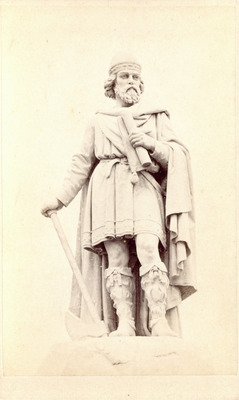
This statue of the 9th century king of Wessex, Alfred the Great, stands in his birthplace of Wantage, England. He was famous for protecting England from Viking invasions and developing an influential law code. The creation of this statue reflected Victorian Britain’s growing interest in his life. It depicts Alfred in armor while holding both an axe and scroll, symbolizing his military and administrative accomplishments.
School of Art/Architecture
Victorian
Publisher
Unknown
Digital Date
2025
Copyright
Physical copy of the carte-de-viste is in the public domain. Digital copy scanned by Rod Library ©2025 Rod Library, University of Northern Iowa.
Creative Commons License

This work is licensed under a Creative Commons Attribution-NonCommercial 4.0 International License
File Format
image/jpeg

Comments
This statue is of Alfred the Great, King of Wessex (849-899). Alfred is considered the greatest king of England’s Anglo-Saxon period. Alfred was born in Wantage, then in the Kingdom of Wessex, the southwestern Anglo-Saxon kingdom in Great Britain. From when he became king in 871 to 880, and again from 892 to 896, King Alfred fought against invading Viking armies. King Alfred was also notable for his law code, often called the “Domboc” or “Doom Book”, which was often credited as setting the standard for English Common Law. By the time of his death in 899, Alfred ruled over all Anglo-Saxons that were not under Viking rule, and he styled himself the King of the Anglo-Saxons.
In the early 1800s, conflict with France during the Napoleonic Wars began to stir up a great deal of anti-French sentiment in Britain, culminating in an academic reassessment of the Norman conquest of England during the Victorian era. Because of this, greater emphasis was placed on the Anglo-Saxon period of medieval England. Alfred the Great became interpreted as a “model king” figure and began to develop a cult of personality among Victorians. Wantage’s statue of Alfred the Great followed a Victorian trend of commemorating Alfred in art and literature, and was one of four statues of him erected during the Victorian era.
The actual sculpture itself was commissioned by the landlord of Wantage, Colonel Robert Loyd-Lindsay, later known as 1st Baron Wantage (1832-1901). The Alfred the Great statue in Wantage was sculpted by Prince Victor of Hohenlohe-Langenburg, known as Count Gleichen (1833 - 1891), who was a nephew of Queen Victoria. He was paid £2000 for the statue. On July 14, 1877, the statue was unveiled by the Prince of Wales (later Edward VII) and his wife Princess Alexandra. The location of the statue was chosen because Wantage was the birthplace of Alfred the Great. It was placed at the location of Wantage’s former townhall, and became the centerpiece of the town’s market square. The statue and their native king remain popular among the people of Wantage, and the square is the site of their annual Anglo-Saxon-themed “Alfred Fest”. The statue was briefly damaged in 2007, when a vandal cut off the statue’s axe-wielding right arm. Since then, the statue has regained both its arm and axe.
The Alfred the Great statue is made of Italian marble, its base is made of granite, and it rises to a height of around nine feet. King Alfred is depicted in armor, wearing a crowned cap-helmet, a short coat of mail (known as a haubergeon), and half-hose bandaged with strips of leather. With his right hand, Alfred lays his battle axe to rest by his side, and with his left hand he holds a scroll to his heart, representing King Alfred’s legal code. The axe and scroll represent the duality of Alfred’s military prowess and his promotion of learning among his people. The statue’s face itself is modeled after its commissioner and presenter, Colonel Loyd-Lindsay.
Bibliography:
Asser. Alfred The Great: Life of King Alfred and other Contemporary Sources. Translated by Simon Keynes and Michael Lapidge. Penguin Books, 1984.
"Fine Arts." Public Opinion 32 (July 1877): 48. https://books.google.com/books?id=bP4GWS9uIRkC&pg=PA48#v=onepage&q&f=false.
Government Art Collection. "Explore: Count Gleichen." Government Art Collection. Accessed September 24, 2025. https://artcollection.dcms.gov.uk/person/gleichen-count/.
Historic England. "Statue of King Alfred, Wantage." Historic England. Accessed September 24, 2025. https://historicengland.org.uk/listing/the-list/list-entry/1198394?section=official-list-entry.
Keynes, Simon. "Alfred the Great and the Kingdom of the Anglo-Saxons." In A Companion to Alfred the Great, edited by Christopher M. Bellitto, Nicole G. Discenza, and Paul E. Szarmach. Brill, 2015.
Love Wantage. "King Alfred's Wantage." Love Wantage. Accessed September 24, 2025. https://lovewantage.uk/king-alfreds-journey-wantage-oxfordshire.
Parker, Joanne. England’s Darling: The Victorian Cult of Alfred the Great. Manchester University Press, 2007. https://doi.org/10.7765/9781526130563.
Tait, Albert. "The fascinating history of Wantage and King Alfred the Great." Oxford Mail (Oxford), April 30, 2023.
The Miriam and Ira D. Wallach Division of Art, Prints and Photographs: Print Collection, The New York Public Library. "Statue of King Alfred the Great, at Wantage, by Count Gleichen." New York Public Library Digital Collections. Accessed September 24, 2025. https://digitalcollections.nypl.org/items/2ded8a10-c530-012f-55c4-58d385a7bc34.
Wantage Town Council. "Wantage Town Council: Oxfordshire, England, UK." Wantage Town Council. Accessed September 24, 2025. https://wantagetowncouncil.gov.uk/.