

Monuments Class Projects
Architect/Sculptor of Monument
Solomon Willard (1783-1861)
Preview
Identifier
15a
Medium
photograph, carte-de-viste
Keywords
Bunker Hill Monument, Charlestown, American Revolution, Obelisk, Neoclassical architecture, Carte-de-visite, Solomon Willard, Nineteenth-century photography, Boston landmarks, Battle of Bunker Hill
Physical Dimensions
4x2.5"
Date of Publication
c. 1865
Name of Monument
Bunker Hill Monment
Date of Completion or Dedication of Monument
6-17-1843
City of Monument
Charlestown, Boston
Location within City
Breed's Hill, Monument Square
State/Province of Monument
Massachusetts
Country of Monument
United States of America
Description
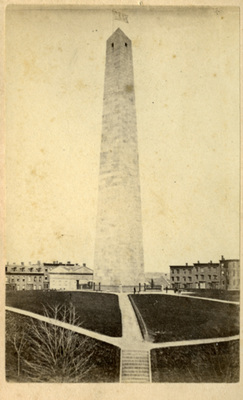
This carte-de-visite depicts the Bunker Hill Monument, a 221 ft granite obelisk which commemorates the Battle of Bunker Hill. The image shows the monument rising above landscaped grounds, with several surrounding rowhouses visible, highlighting its prominent placement within the Charlestown neighborhood.
School of Art/Architecture
Egyptian Revival
Digital Date
8-21-2025
Copyright
Physical copy of the carte-de-viste is in the public domain. Digital copy scanned by Rod Library ©2025 Rod Library, University of Northern Iowa.
Creative Commons License

This work is licensed under a Creative Commons Attribution-NonCommercial 4.0 International License
File Format
image/jpeg

Comments
The Bunker Hill Monument commemorates the Battle of Bunker Hill. The battle was fought on June 17, 1775, and was one of the first major battles in the Revolutionary War. While the British won the battle, they suffered a lot more casualties than expected. The battle itself provided proof that the Americans could stand up to the powerful British army, and acted as a morale booster to the Americans. Bunker Hill became a powerful symbol for American courage where the order “Do not fire until you see the whites of their eyes” allegedly was given.
This monument’s construction began in 1825, two years after the Bunker Hill Monument Association was founded. Its goal was to honor those who fought in the battle there. The cornerstone was laid by the Revolutionary war veteran Marquis de Lafayette during a large public ceremony, which thousands of people attended. Most of the funding for the monument came from public donations and community efforts. Despite some fundraising challenges, the monument was finally finished in 1843.
The Bunker Hill Monument is a 221 foot granite obelisk, designed by the architect Solomon Willard (1783–1861). The obelisk style was influenced by the obelisks from ancient Egypt, and reflected the early 19th-century fascination with ancient architecture as symbols of pride. It was built in a period where Americans sought to connect with the nation’s new identity, comparing it to those of classical civilizations. The monument’s solid unembellished form is a powerful statement of national pride.
The monument itself is very simple, it does not have decorative carvings or inscriptions, which in turn emphasizes the solemn and dignified purpose of the obelisk. Inside visitors can climb a staircase that leads to an observation room at the top of the monument. Near the base of the obelisk stands a statue of Colonel William Prescott, who was one of the American commanders in the Battle of Bunker Hill. He is depicted giving the legendary order to his troops of “[Do] not fire until you see the whites of their eyes," (“Colonel William Prescott: A Glorious Immortality (U.S. National Park Service)”).
The Bunker Hill Monument stands on Breed’s Hill in Charlestown, Massachusetts, which was the actual location of the Battle of Bunker Hill. In order to defend the hill, the American forces built and defended a redoubt against British advances. From its dominant position, the memory of the battle is linked to the city that played a central role in the beginning of the Revolutionary War. The park surrounding the monument offers a reflective space for visitors. The Bunker Hill Monument has not been altered significantly since it was completed in 1843. Since its completion, the grounds and park surrounding the monument have improved, and there is a small museum that was built to interpret the history of the site.The statue of Colonel Prescott was added in 1881, and the National Park Service took over care of the Bunker Hill Monument in 1976, ensuring its preservation as a part of the Boston National Historical Park.
Bibliography:
American Battlefield Trust. “Battle of Bunker Hill Facts & Summary.” American Battlefield Trust, www.battlefields.org/learn/revolutionary-war/battles/bunker-hill.
“Battle of Bunker Hill Historical Information.” Bunker Hill Monument Association, Bunker Hill Monument Association, 10 Mar. 2025, bunkerhillmonumentassn.org/battle-of-bunker-hill-historical-information/#battle.
“Battle of Bunker Hill Historical Information - Bunker Hill Monument Association.” Bunker Hill Monument Association, 10 Mar. 2025, bunkerhillmonumentassn.org/battle-of-bunker-hill-historical-information/#battle. Accessed 13 Nov. 2025.
“Bunker Hill Monument - Boston National Historical Park (U.S. National Park Service).” Nps.gov, 2016, www.nps.gov/bost/learn/historyculture/bhm.htm.
“Colonel William Prescott: A Glorious Immortality (U.S. National Park Service).” Nps.gov, 2020, www.nps.gov/articles/000/william-prescott.htm?utm_source=chatgpt.com. Accessed 13 Nov. 2025.
Packard, Alpheus S. Prof. History of the Bunker Hill Monument. Kessinger Publishing, 1853.
Purcell, Sarah J. Commemoration, Public Art, and the Changing Meaning of the Bunker Hill Monument. vol. Vol. 25, The Public Historian, 2003.